Scripture, Tradition, and the Inheritance of the Church Fathers
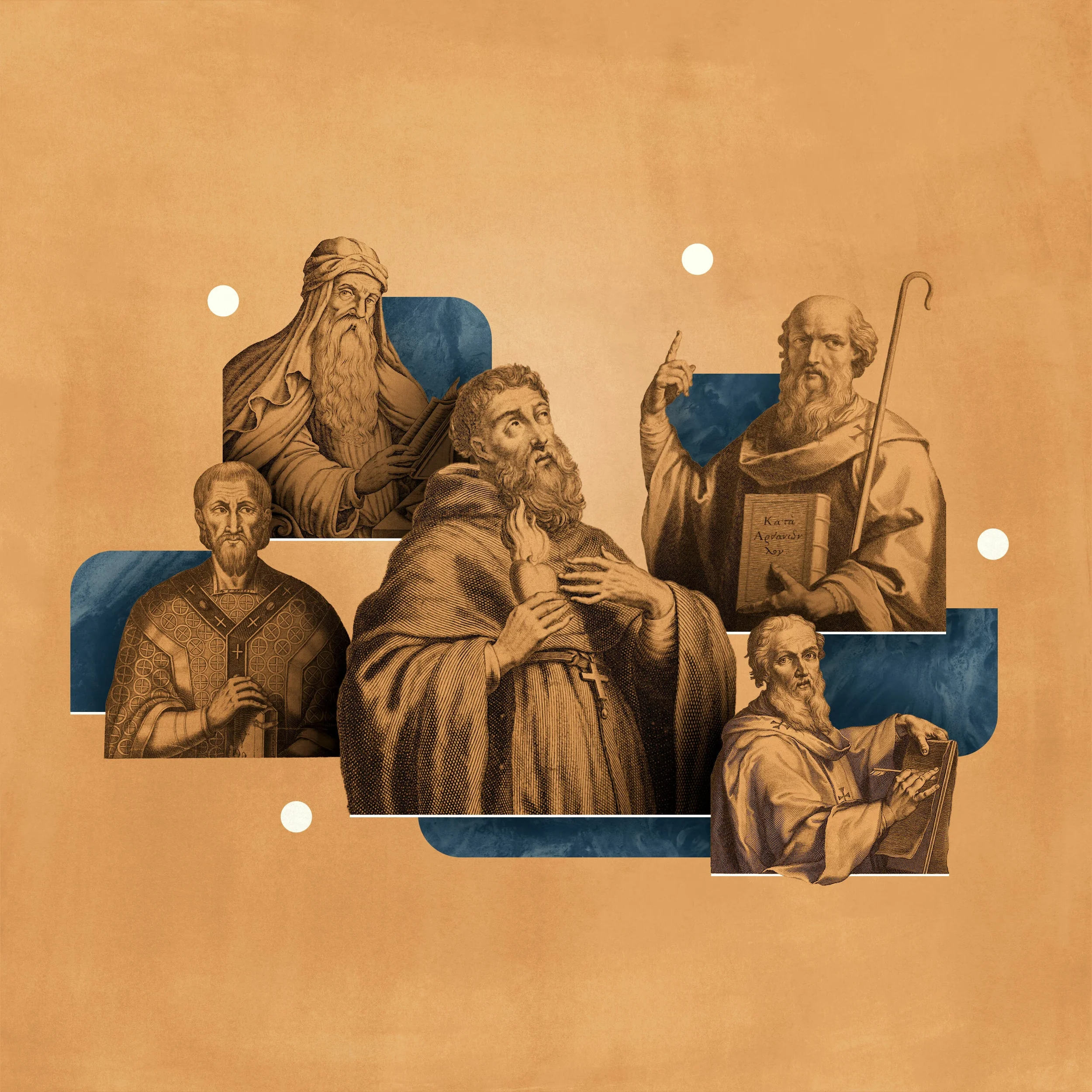
The Protestant Reformation is often presented as a return to Scripture and a decisive break from the traditions of the Roman Catholic Church. At the heart of the Protestant movement was the conviction that Scripture possesses the highest and final authority in matters of Christian faith and doctrine. This principle became known as sola Scriptura, or “Scripture alone.” However the historical reality is more nuanced than the phrase may initially suggest. The Reformers did not discard the theological inheritance of the centuries that preceded them. They rejected the authority of Rome in certain areas, challenged later ecclesiastical traditions, and insisted that Scripture must stand above the pronouncements of popes and councils. Nonetheless, they continued to rely upon the writings of the Church Fathers, ancient creeds, ecumenical councils and centuries of Christian interpretation. Protestantism therefore represented not a complete theological reset, but a reordering of authority within an existing Christian theological inheritance.
The classical Protestant position was not that everything taught by the church before the Reformation was false. Rather, the Reformers argued that Scripture was the supreme standard by which every other authority had to be tested. Church councils, creeds, church fathers, and theologians could however provide valuable testimony and assistance. The Westminster Confession of Faith, for example, explicitly recognizes councils and synods as useful for settling controversies and establishing rules for worship and government, while simultaneously acknowledging that such assemblies can err and therefore must ultimately be judged according to Scripture. The same confession states that the supreme judge by whom religious controversies are to be determined is “the Holy Spirit speaking in the Scripture.” Thus, Protestantism did not necessarily eliminate tradition; it subordinated tradition to Scripture.
This distinction created the characteristic Protestant framework: Scripture as the final authority, still with the inherited Christian tradition functioning as a subordinate witness. The Reformers could therefore appeal to the early church when they believed the Fathers supported their understanding of Scripture. The writings of the Fathers were not treated as irrelevant; they remained historically and theologically significant precisely because the Reformers believed the ancient church could provide evidence concerning how earlier Christians had understood the faith.
Consequently, Protestant theology remained deeply connected to the theological developments of the early and medieval church. The Reformers inherited doctrines that had been debated, articulated, and systematized for centuries before Luther, Calvin, Zwingli, and the other Reformers appeared. In many cases, they did not discard these doctrines; they accepted them as fundamental Christian truth and sought to defend them from Scripture.
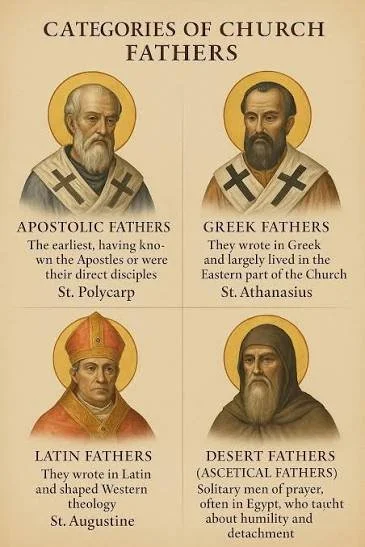
One of the clearest examples is the doctrine of the Trinity. The Protestant Reformers did not generally reject the Trinitarian framework established within the ancient creedal tradition. They inherited a doctrine that had developed through centuries of controversy involving figures such as Tertullian, Athanasius, Augustine, and the Cappadocian Fathers, and that had been articulated through councils such as Nicaea and Constantinople. The Protestant confessions consequently continued to affirm the Father, Son, and Holy Spirit within the Trinitarian framework inherited from the ancient church.
This is significant because the Protestant doctrine of the Trinity cannot be understood simply as a doctrine that emerged independently from a sixteenth-century reading of Scripture. The Reformers inherited an already-developed theological vocabulary concerning the nature of the Most High, the relationship between the Father and Son, the divinity of the Holy Spirit, and the meaning of terms such as “person,” “essence,” and “substance.” They accepted the conclusions of the ancient creedal tradition.
The same is true of Christology. Protestantism inherited the ancient church's understanding of Christ as fully divine and fully human. The theological controversies that produced the Nicene and later Christological formulations had occurred centuries before the Reformation. The Reformers did not generally attempt to reconstruct the doctrine of Christ from the beginning. Instead, they inherited the conclusions of the ancient church and incorporated them into Protestant confessional theology. The Protestant Reformation therefore represented a major challenge to the authority and practices of medieval Rome without constituting a rejection of the ancient creedal understanding of Christ.
Augustine's influence provides an even more direct example of theological inheritance. Augustine of Hippo became one of the most influential theological figures in the Western Christian tradition, particularly concerning sin, grace, salvation, predestination, and the church. Both Luther and Calvin engaged extensively with Augustinian thought. Protestant doctrines concerning humanity's fallen condition, divine grace, election, and the inability of human beings to save themselves cannot be understood apart from the larger Western theological tradition in which Augustine played a dominant role.
This does not mean that Luther or Calvin simply reproduced Augustine. They did not. They selected, developed, intensified, and sometimes departed from aspects of Augustinian theology. Nevertheless, there is a recognizable historical progression: biblical writings were interpreted by early Christian theologians; those interpretations contributed to the development of Western theology; Augustine profoundly shaped that theology; medieval theologians continued to develop it; and the Reformers inherited and reworked portions of that theological tradition. Protestant theology therefore contains both continuity and discontinuity with the Christianity that preceded it.
The doctrine of justification illustrates this tension particularly well. The Reformers famously emphasized justification by faith and opposed the medieval Catholic understanding of justification as they understood it. Sola fide became one of the defining principles of the Reformation. Yet the Reformers did not approach the question without reference to the Christian tradition. They studied earlier theologians and searched the writings of the Fathers for evidence concerning grace, faith, righteousness, and salvation. Their argument was therefore not simply “the Fathers are wrong; Scripture is right.” Rather, they argued that their interpretation of Scripture represented a recovery of apostolic Christianity and, in many instances, sought historical support for that claim within the writings of the early church.
The sacraments provide another example of what Protestantism retained and transformed. The Reformers rejected significant aspects of the medieval Catholic sacramental system and disagreed with Rome concerning the nature and function of the sacraments. Nevertheless, baptism and the Lord's Supper remained central to Protestant Christianity. They were not discarded as relics of Catholicism. Instead, their meaning and function were reinterpreted according to different Protestant theological systems. Lutherans, Reformed Christians, Anglicans, Anabaptists, and later Protestant traditions developed different understandings of baptism and communion, demonstrating that the Reformation was not simply a rejection of sacramental Christianity but a restructuring of it.
The same pattern can be seen in church organization. Protestantism rejected papal supremacy and challenged the medieval ecclesiastical hierarchy, but it did not conclude that organized church authority was inherently illegitimate. Protestant traditions continued to establish ministers, elders, pastors, bishops in some traditions, church courts, councils, confessions, disciplinary structures, and formal statements of doctrine.
This is one of the most important distinctions between Roman Catholicism and classical Protestantism. Catholicism traditionally understands Scripture and Sacred Tradition within the authoritative teaching structure of the Church. Classical Protestantism instead placed Scripture above the institutional church and treated councils, Fathers, traditions, and confessions as subordinate authorities. The Protestant revolution therefore changed the location of final doctrinal authority without eliminating the need for interpretation, theological reasoning, or historical testimony.
Even the biblical canon illustrates the complexity. Protestants inherited the Scriptures through the history of the Christian church rather than discovering an entirely new collection of books at the Reformation. At the same time, Reformers reassessed the status of certain books traditionally included in the Western Christian canon. The Protestant Old Testament consequently differed from the Roman Catholic canon in its treatment of the deuterocanonical books. Again, the Reformation involved the reassessment of an inherited tradition, not the creation of Christianity from nothing.
The result was therefore a theological paradox. Protestantism defined itself in part by its protest against ecclesiastical tradition, yet it remained deeply dependent upon inherited Christian tradition. It rejected the idea that the Church could establish doctrine merely by appealing to its own authority, but it continued to employ doctrines, terminology, and interpretations that had been developed long before the Reformation.
This does not invalidate Protestantism. Rather, it helps clarify what Protestantism actually was.
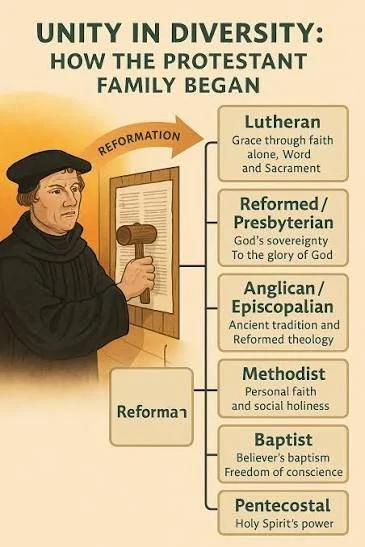
Protestantism itself was not a single theological system frozen in the sixteenth century. Lutheran, Reformed, Anglican, Anabaptist, Baptist, Methodist, Restorationist, and other movements emerged with differing approaches to Scripture, prophecy, and Christian practice. Each inherited something from earlier Christianity while rejecting or modifying other elements.
Consequently, the Protestant Reformation should not be understood simply as a straight line from “Catholicism” to “Christianity.” It was a process of rejection, retention, reinterpretation, and development.
This becomes particularly significant when examining later movements such as Adventism. Adventism did not emerge directly from the ancient church, nor did it emerge independently from the Bible. It emerged within the nineteenth-century Protestant environment, particularly through the Millerite movement. Consequently, it inherited not only the Protestant principle of biblical authority but also portions of the Protestant theological and prophetic inheritance that preceded it.
The Protestant Reformation changed the hierarchy of authority. The Reformers continued to build upon ancient creeds, the writings of the Fathers, Augustinian theology, inherited Christology, Trinitarian doctrine, sacramental practices, church structures, and established interpretations of Scripture. Therefore, the Protestant framework can be understood as a combination of Scripture and historical inheritance. Scripture was declared the final judge, but the Reformers continued to reason within a theological world shaped by those who came before them.
And this is precisely why tracing the history matters.
If a doctrine existed before the Reformation, was retained by the Reformers, was passed into later Protestant traditions, and eventually became part of another movement, then identifying that lineage does not by itself prove the doctrine true or false. What it does is expose the historical pathway by which the doctrine arrived where it is today.
Once that pathway is visible, the question becomes much more fundamental:
Was the doctrine inherited because it is plainly taught in Scripture—or because generations of theologians had already established a framework through which Scripture came to be interpreted?
That is where the examination must ultimately return: not to the Fathers, not to the Reformers, and not to the institutions that came afterward, but to the Scriptures themselves.
Sources
Westminster Confession of Faith (1646), chs. 1, 31.
Augsburg Confession (1530), Arts. VI, XX.
Calvin, John. Institutes of the Christian Religion.
Augustine. On the Trinity.
Athanasius. On the Incarnation.
Irenaeus. Against Heresies.
Tertullian. Against Praxeas.
